Geography is one of the main subjects or “feast” in a Charlotte Mason education. It starts with Year 0 or the reception year, aka Kinder, and continues until Year 6 (Grade 6). In the reception year, geography is taught as a story using a living book. Starting Year 1, geography books are already used. We use the Ambleside Online Geography Plan for Year 1-6.
Why study Geography?
Geography is not just about maps and flags, which your kids will protest as boring subject. It is more than that. Geography is about real people, real places and real events. In a Charlotte Mason method, geography is taught through living books, or books that make the children go to different places and events without leaving their homes…through their imagination. It is also teaching the kids how different people live (or lived) in different places in different times.
What books we use
For the Reception Year, we use “Seven Little Sisters who Live on the Round Ball that Floats in the Air” by Jane Andrews. It is a story type geography book about the seven continents and how the people live in each continent. While the stories here are about the lives from about decades or centuries ago, they are still interesting and engaging.
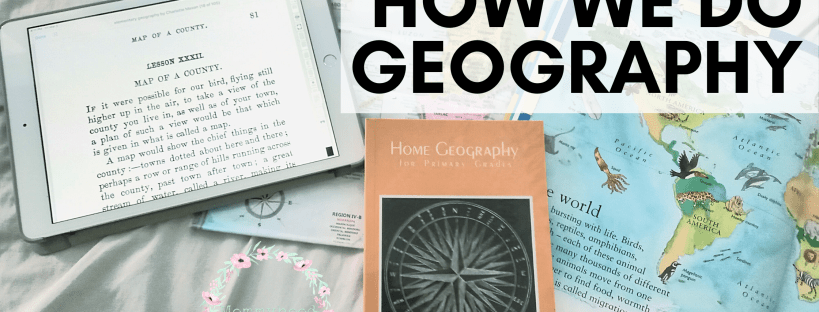
For Years 1-6, the Ambleside Online recommends these two books to be used hand in hand: Elementary Geography by Charlotte Mason, and Home Geography for Primary Grades by CC Long. So many topics are covered in six years and most of them are taught in science subject in traditional schools/curriculum. Here is the summary of the Ambleside Online geography plan:
| Term 1 | Term 2 | Term 3 | |
| Year 1 | CM: Our World Part 1; Long: Position | Long: How the Sun Shows Direction, How the Stars Show Direction | CM: Our World Part II |
| Year 2 | Long: How the Compass Shows Direction; CM: The Points of the Compass, The Mariner’s Compass | CM: Our World and Other Worlds Part I, Our World and Other Worlds Part II, Day and Night | CM: Poles and Axis, The Four Seasons Part I, The Four Seasons Part II |
| Year 3 | CM: Hot Countries and Cold Countries Part I and Part II, Parallel Lines | CM: Sunrise and Sunset, Why the Sun Rises and Sets, Mid-day Lines | Long: How to Tell Distance, Pictures and Plans; CM: The Plan of a Room, The Plan of a Town, Map of a Country, How Maps are Made |
| Year 4 | CM: The Surface of the Earth Part I and Part II, Highlands and Lowlands; Long: Plains, Hills Mountains and Valleys | Long: Rain, Wind and Snow, How Water is Changed to Vapor, How Vapor is Changed to Water, Dew Clouds and Rain, How Rivers are Made, More about Rivers; CM: Rivers | Long: Work of Flowing Rivers, Waterdrop’s Story; CM: Countries, The Waters of the Eart Part I and II, The Oceans and their Parts |
| Year 5 | Long: A Map, Forms of Land and Water, More about Forms of Land and Water, A Trip to the Highlands | Long: Useful Vegetables, Useful Grains, Fruits, Useful Plants | Long: Forest Trees, Flowers, What is Necessary to Make Plants Grow |
| Year 6 | Long: The Parts of Animals, The Covering of Animals, Uses of Animals | Long: Things Found in the Earth, More about Things Found in the Earth | Long: How People LIve and What They are Doing, More about What People are Doing, A Review Lesson |
Aside from the geography books mentioned above, there are also living books used. Here are the living geography books that are used in Ambleside Online curriculum:
| Year | Living Books | Author/s |
| 1 | Paddle to the Sea | Holling C Holling |
| 2 | Tree in the Trail Seabird | Holling C Holling Holling C Holling |
| 3 | Marco Polo: His Travels and Adventures | George Makepeace Towle |
| 4 | Minn of the Mississippi Material World: A Global Family Portrait What the World Eats | Holling C Holling Peter Menzel Faith D’Aluisio and Peter Menzel |
| 5 | The Complete Book of Marvels (The Occident and The Orient) Material World: A Global Family Portrait What the World Eats | Richard Halliburton Peter Menzel Faith D’Aluisio and Peter Menzel |
| 6 | The Complete Book of Marvels (The Occident and The Orient) The Story of David Livingstone Material World: A Global Family Portrait What the World Eats | Richard Halliburton Vautier Golding Peter Menzel Faith D’Aluisio and Peter Menzel |
| 7 | The Brendan Voyage How the Heather Looks | Tim Severin Joan Bodger |
| 8 | Christopher Columbus, Mariner or The Life of Christopher Columbus Kon Tiki or The Discovery of Muscovy or The Discovery of Guiana | Samuel Eliot Morison Edward Everett Hale Thor Heyerdahl Richard Hakluyt Sir Walter Raleigh |
| 9 | Longitude or London to Land’s End Lewis and Clark: Undaunted Courage A Journey to the Western Islands of Scotland | Dava Sobel Daniel Defoe Stephen Ambrose Samuel Johnson |
| 10 | Eothen The Oregon Trail Narrative of Six Weeks in Ireland | Alexander Kinglake Francis Parkman William Bennet |
| 11 | The World: Travels 1950-2000 Endurance: Shackleton’s Incredible Voyage Under the Tuscan Sun | Jan Morris Alfred Lansing Frances Mayes |
| 12 | Full Tilt | Dervla Murphy |
Map drills
We do map drills whenever we encounter a place in our lessons. Most of the time, we do map drills during World History and Philippine History. We have both the world and Philippine maps and I am planning to buy a globe so my Kinder boy can visualize more how the Earth looks like and how it rotates. Doing map drills during lessons will help the child visualize the story or information that she/he has read or heard. Map drills can also help the child see the “bigger” picture of what he/she has read.

We also search the internet if the place is so small that our world map does not capture the place. It is also helpful to watch some videos/documentaries about the places or people that were tackled during the lessons. In this way, the children will have a “richer” lesson.
 Mommyhood Journey