
Our homeschool provider has recommended Bloom’s Taxonomy in grading our kids. During the orientation on how to grade the Charlotte Mason way, I was a bit confused on how to do it. Last night, I found some websites explaining how to compose Higher-Order Thinking Skills questions. And while reading about it, I realized that this is a good training for the kids in order to think critically and creatively, think out-of-the-box and analyze the situations in real life.
What is Bloom’s Taxonomy?
Bloom’s Taxonomy is a framework used by educators that “target not only subject matter but also the depth of learning they want students to achieve, and to then create assessments that accurately report on students’ progress towards these outcomes” (Centre for Teaching Excellence, University of Waterloo).
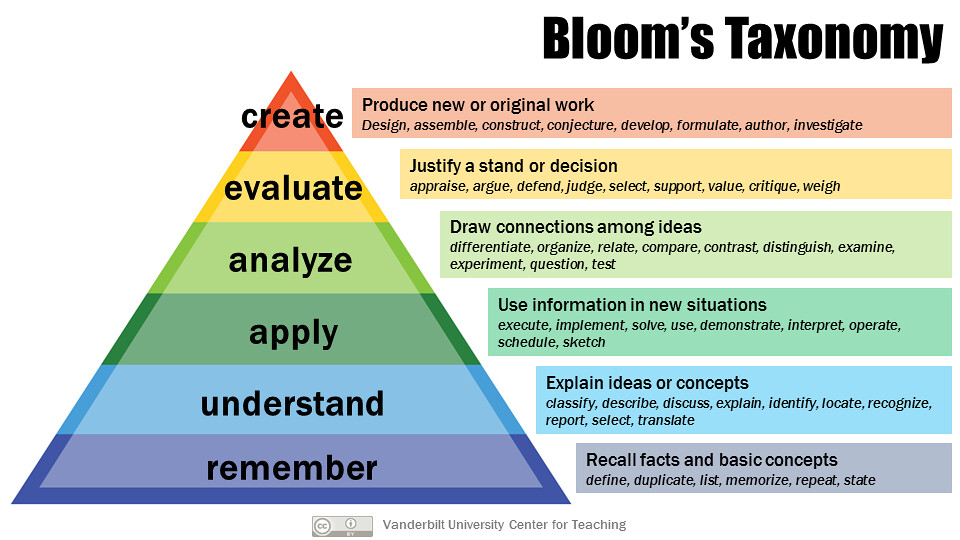
There are 2 categories in Bloom’s Taxonomy: Lower-Order Thinking Skills (LOTS) and Higher-Order Thinking Skills (HOTS). It is said the Higher-Order Thinking Skills lead to effective study as the students are moved beyond remembering and understanding, which are usually covered in usual tests and exams. HOTS lead the students to apply, analyze, synthesize and evaluate what they have learned and later on create new ideas. With this process, the brain can truly and deeply learn information that was introduced to the students.
Levels of Bloom’s Taxonomy
The levels of Bloom’s Taxonomy include the following:
Lower-Order Thinking Skills: Remember, Understand
Higher-Order Thinking Skills: Apply, Analyze, Synthesize, Evaluate, Create
Some literatures do not have “Synthesize” as it is part of “Analyze.”
Remember. Remembering is simply the ability to memorize and recall important terms from the information that was learned. Facts and details are “remembered” and not necessarily “understood.” Questions relating to this level include asking for the definitions, descriptions, among others.
Understand. Understanding or comprehension means explaining the concept or the main ideas by interpreting, classifying, comparing, summarizing and explaining.
Apply. Application is the first level in HOTS. It means transferring what the students learned to their own life or context. It allows the students to recognize or use the information to real-life situations. Questions can be asking for concrete examples.
Analyze and Synthesize. Analysis is relating the parts with each other. It is dividing the information into small parts and relates them into whole. It is seeing how the parts or information are connected with each other. It differentiates, organizes and attributes the information that was presented to the students. It would be best if the student is able to relate the parts on his or herself and without help from any adult. Synthesis is considering individual elements together so the students can generate conclusion/s about the information. It sees from “parts” to “whole” or putting the elements together to form a whole.
Evaluate. Evaluation is making judgements based on the standards by checking and critiquing a concept or argument so that students can form an opinion. It is important that students can make a judgement and support it with reason and evidence. Students are asked if they agree or disagree with the information presented to them or if they like or dislike them.
Create. Creating is putting things together to create a new or functional whole. It involves reorganizing and combining the elements or parts in a new structure through planning. This is the highest level in Bloom’s Taxonomy.
| Category/Levels | Keywords | Sample Questions | Sample Activities |
|---|---|---|---|
| Remember | Memorize, define, identify, list | How would you define… What are the… List the names/places of …. | Make a list of main events/characters Make a chart showing… Write what you can remember about… |
| Understand | Describe, explain, classify | How would you differentiate… What is the main idea of… How did… How would you compare… What is the main idea of … | Make a cartoon strip on the sequence of events Retell the story in your own words. Paint a picture of what you like about the story. |
| Apply | Concrete examples, demonstrate, put to use, manipulate, solve, narrate | How would you change… Why does …. work? How would you develop a set of instructions about…? What happens if you … with ….? What approach would you use to …? What other way can you think of …? | Make a scrapbook about what you think about… Perform a play based on the story. |
| Analyze | Distinguish, explain, relate, importance, different perspective, organize, attribute, differentiate | What is the significance of…? What is the relationship between….? What things justify….? Why do you think …? | Make a chart to show the critical stages of … Make a review of the film/story. Make a chart showing the relationship of … |
| Synthesize | Arrange, combine, create, formulate, generalize, condense and restate, compare and contrast | What makes … similar and different from …? How can you paraphrase …? What could be changed to improve …? What way would you design …? What outcome would you predict for …? What can you point out about …? | (same as analyze) |
| Evaluate | Assess, critique, determine, check, justify, recommend | What is your opinion about …? What evidence and reasons support this? Do you agree that …? How would you improve this? If you were …, would you do the same? Which argument is stronger and why? What alternative can you think of or suggest for …? What would happen if …? | Write a letter to … advising on changes needed at… Write a report. Prepare a case to present your view. |
| Create | Generate, produce, plan, | What information would you use to prioritize…? What model can you create about…? What experiment can you do to demonstrate…? How can this information be told in the form of story or poem? What criteria would you use to assess…? | Create a new product. Create a business proposal. Sell an idea. Devise a way to… Compose a rhythm or song about… Invent a machine to help the character in the story. |
Sources:
The Learning Center – University of California at Chapel Hill
 Mommyhood Journey
One thought on “Bloom’s Taxonomy with sample questions”