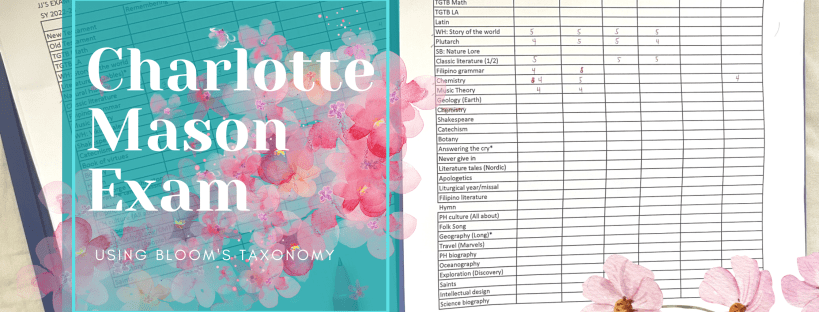
So our exam week for Term 1 was recently concluded. We are still doing Charlotte Mason education at home so our dynamics are kind of different from the traditional ones.
A brief background, in Charlotte Mason education, we use living books instead of textbooks. These living books are written by people who are passionate about the subject and well-written that the people (and kids) who will read them can imagine the story. Also in Charlotte Mason, narration, whether in oral or written form, is necessary so that the kids will imprint in their memory the lesson that they heard or read.
For the exam, we also use the Charlotte Mason way of assessing the kids. This is really different from the traditional exams because here, we check what the kids know and not what they do not know. Seems confusing? Here’s an example:
| Method | Sample Question |
| Traditional | What is science? |
| Charlotte Mason | Tell me what you know about science |
In Bloom’s Taxonomy, the kids are trained to be critical thinkers and letting them explore their thoughts and feelings. Bloom’s Taxonomy is a framework used by educators that “target not only subject matter but also the depth of learning they want students to achieve, and to then create assessments that accurately report on students’ progress towards these outcomes” (Centre for Teaching Excellence, University of Waterloo).
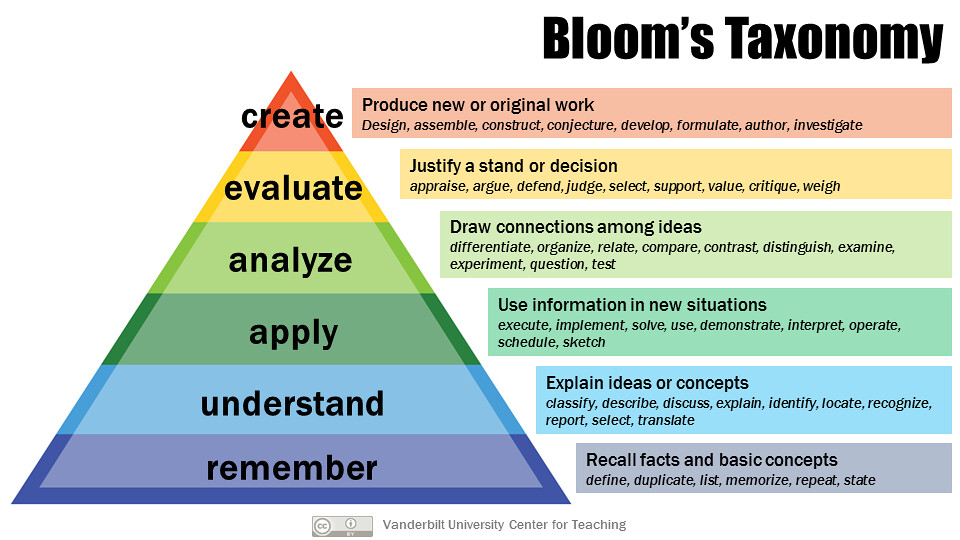
To know more about Bloom’s, you can check my blog about it here.
Application of Bloom’s Taxonomy in Charlotte Mason exam
Since Charlotte Mason exams are different, they are also graded differently. One question (or activity) can have all the levels or just selected levels. Exam items can be written, drawn, painted, or any way the kids think of that will show their answers.
I also use a 4-scale rating for the exam: 4 – excellent, 3 – satisfactory, 2 – improving/developing, 1 – needs improvement. In descriptive form, 4 is given when the student answered the question with confidence, accuracy, strong emphasis, and related it to anything applicable to the topic. Rating 3 is given when the student answered with impartiality or partially accurate without strong emphasis on what he/she thinks and feels but can relate it to something applicable. Rating 2 is given when the student answered with inaccurate details and relates it weakly to something while rating 1 is given if the student did not totally recall the story and could not relate it to anything.
Now, let’s take some sample questions using the Bloom’s Taxonomy and apply the 4-scale rating.
| Rating | Remember | Understand | Apply | Analyze | Evaluate | Create |
| Tell me the story of Creation | ||||||
| 4 | retold the story with accurate details | was able to identify the main idea of the story accurately | was able to confidently interpret the story | was able to relate the story and create meaningful connections especially with other subjects or topics | strongly expressed opinions and thoughts about the story | came up with personal illustrations, designs, methods independently |
| 3 | retold the story with partial accuracy | was able to identify the main idea of the story partially | was able to interpret the story with little uncertainty | was able to relate the story but with minimal assistance from an adult | expressed opinions | came up with personal illustrations, designs, methods independently |
| 2 | retold the story with inaccurate details | was able to identify the main idea but with weak points | interpreted the story with uncertainly | cannot relate the story unless assisted by an adult | expressed opinions and thoughts but with uncertainty or assistance from an adult | has ideas but do not know how to do it |
| 1 | cannot remember the story | was not able to identify the main idea of the story | was not able to interpret the story | no connection was made even with assistance | no opinion was given even with assistance from an adult | shown no interest in creating designs |
As you can see, Bloom’s Taxonomy can really train the kids on how to independently process the information that they heard or read and that they can express their thoughts or opinions about it.
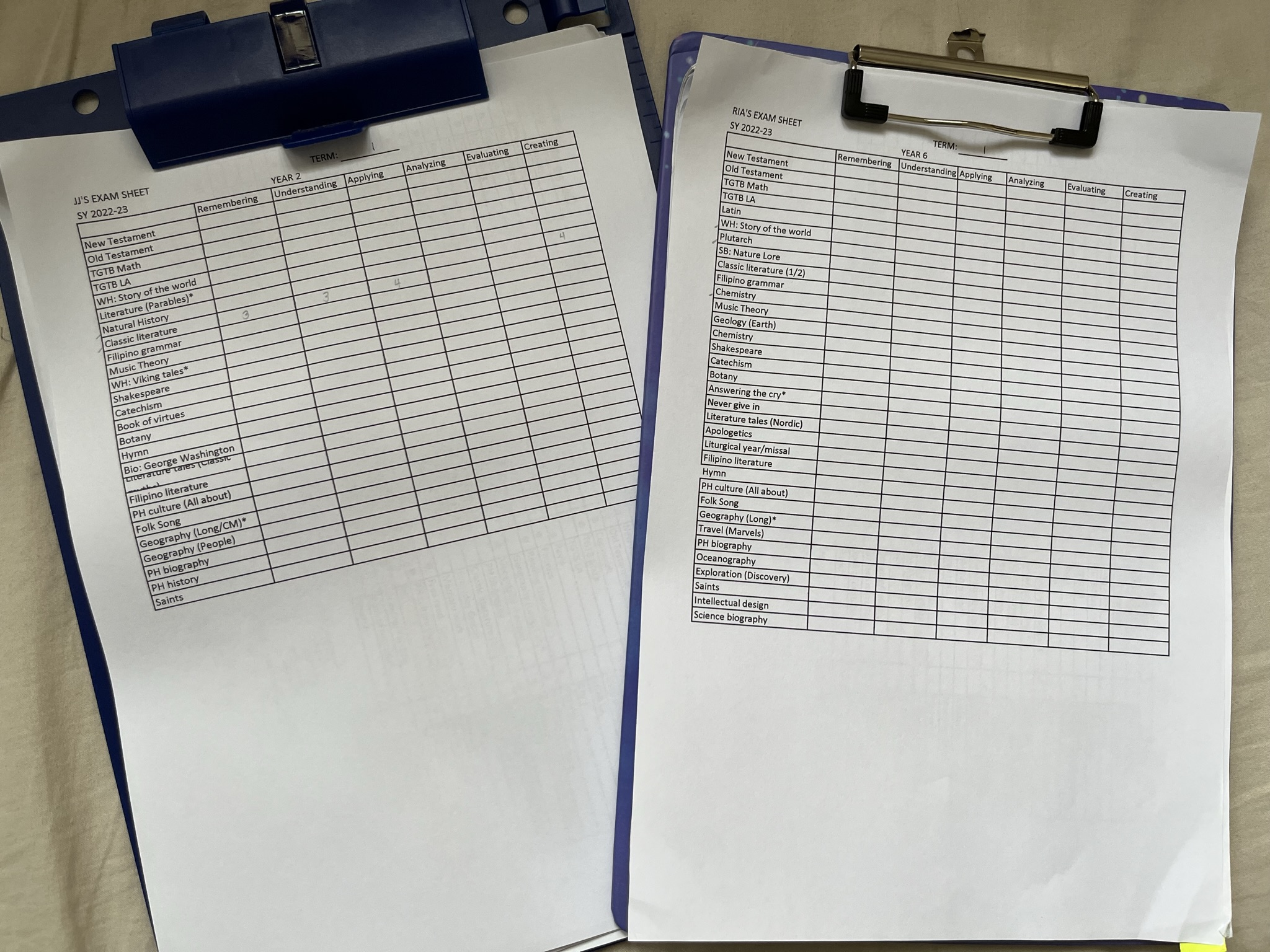
I have printed my kids’ exam sheet so that I will just put their rating after they answer the questions (or activities). Then I input the rates for averaging in spreadsheet to generate their Term Assessment rating. This year, I want to implement the letter-scale rating since we are enrolled in a US homeschool provider.
To know more about the gentle way of learning, I recommend the book of Karen Andreola “A Charlotte Mason Companion: Personal Reflections on the Gentle Art of Learning”
On the art of narration, which is the heart of Charlotte Mason education, I highly recommend Karen Glass’ Know and Tell: The Art of Narration or the kindle version.
(Note: Affiliate links included above. I may gain a minimal commission if you purchase through my links)
Happy homeschooling!
 Mommyhood Journey